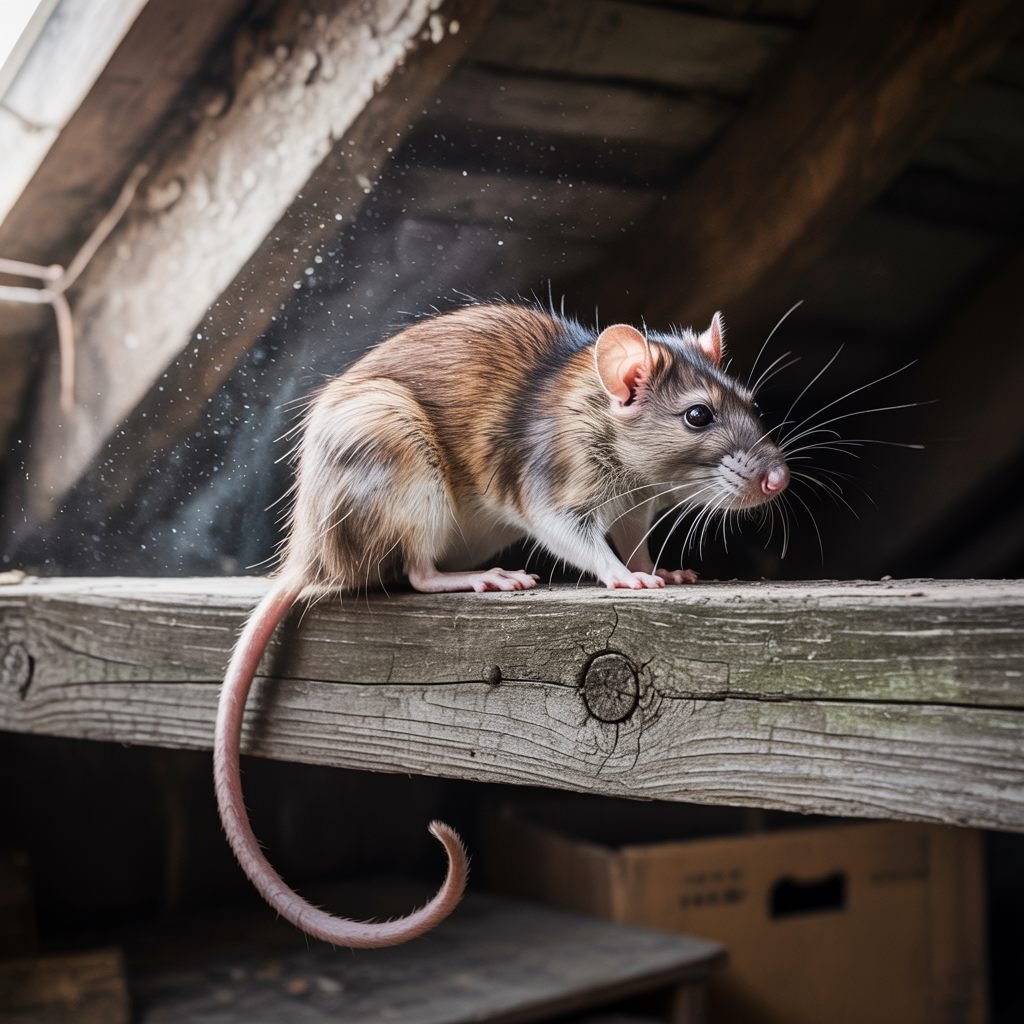
Florida's mild winters mean rodents never really get a dormant season — rats and mice stay active year-round, seeking the stable shelter, food and water your home provides. In Tallahassee they're a particular problem in wooded neighborhoods and older homes where rooflines, crawl spaces and utility penetrations give them easy access.
Roof rats and house mice
Roof rats are the dominant rat in the Southeast. True to the name, they're excellent climbers that enter high — along rooflines, through soffit and eave gaps, and via tree limbs and utility lines touching the house. Once in the attic they nest, chew wiring (a genuine fire risk), and contaminate insulation. House mice enter lower, through gaps as small as a dime, and establish quickly in garages, wall voids and kitchens.
Why they're more than a nuisance
- Fire risk — gnawed electrical wiring is a leading hidden cause of house fires.
- Contamination — droppings and urine on food-prep surfaces and in pantries spread bacteria and trigger allergies.
- Structural & insulation damage — nesting shreds attic insulation and reduces efficiency.
- They multiply fast — a small entry problem becomes an established population within weeks.
Trapping alone doesn't solve it
This is the key point most people miss. Removing the rodents currently inside does nothing about the gap they used to get in. In a Tallahassee neighborhood with continuous pressure from woods and neighboring lots, an unsealed home simply gets reoccupied. Effective rodent control is exclusion first — sealing the entry points — then trapping to clear what's already inside.
Our three-part approach
- Inspection — we find every entry point: roofline and soffit gaps, crawl-space vents, utility and plumbing penetrations, garage door gaps, and tree limbs bridging to the roof.
- Exclusion — sealing those gaps with rodent-proof materials that hold up, so the problem doesn't recur.
- Removal — trapping to clear the active population, with follow-up to confirm success.
Where nesting has contaminated insulation, we advise on cleanup and sanitation as well. We don't rely on interior poison, which leaves rodents to die inside walls and creates a worse odor problem than you started with.
Prevention
Trim tree limbs back from the roof, seal utility penetrations, keep firewood and clutter away from the foundation, and store pet food in sealed containers. Quarterly service includes monitoring so a new entry attempt is caught early. If you're hearing scratching in the attic or finding droppings, book a free inspection — we'll identify the entry points and give you an exact quote to seal and clear them.
Ready for a free inspection?
Tell us what you're seeing. A licensed technician identifies the pest and the entry points and quotes an exact price — with no obligation.